
Commercial real estate audits from 2024 indicate that 35% of Austin businesses waste up to 150 square feet of expensive floor space due to poor furniture scaling. It’s a costly mistake that turns a professional boardroom into a cramped, awkward environment. If you’ve ever struggled to squeeze a chair past a colleague during a high-stakes presentation, you know that the wrong conference table dimensions can derail your office’s daily efficiency. You deserve a workspace that feels intentional rather than accidental.
You likely believe that a larger table signifies more collaboration, but the reality is often a logistical headache that hurts your bottom line. This guide helps you master the logistics of room planning with precise seating charts and Austin-specific spatial strategies. We’ll show you how to select a table that complies with local 2026 fire codes and actually fits through your building’s freight elevator. You’ll learn the smart way to calculate 36-inch clearance zones and maximize your seating capacity for a high-value, professional result.
Key Takeaways
- Determine the ideal conference table dimensions for your specific industry to ensure your furniture choice reflects your firm’s professional identity.
- Apply the “30-inch rule” to optimize seating capacity without sacrificing the executive comfort your leadership team expects.
- Utilize the 48-inch clearance strategy to eliminate room congestion and prevent chair damage against office walls.
- Learn to map your space effectively by accounting for hidden obstacles like door swings and pillars common in Austin’s unique office layouts.
- Make a smart investment by choosing modular designs or premium preowned assets that provide high-end quality at a lower price point.
Standard Conference Table Dimensions for Austin Offices
Choosing the right conference table dimensions isn’t just about aesthetics; it’s a logistical calculation that impacts your bottom line. In Austin’s competitive real estate market, every square foot counts. Whether you’re a lean tech startup in the Silicon Hills or an established law firm on Congress Avenue, your furniture must serve your specific workflow. Most industry-standard tables sit at a fixed height of 30 inches. This height accommodates standard office chairs and ensures ergonomic comfort during long sessions.
Smart office planning requires balancing three variables: table size, room dimensions, and seating density. Don’t fall into the trap of over-sizing. We recommend a Smart approach: measure for your 90% use-case. If your team usually meets in groups of six, don’t waste budget and space on a 20-person table that only gets used once a year. Data from 2024 office utilization studies shows that 82% of meetings involve fewer than four people. Prioritize the daily grind over the annual board meeting to maximize your investment.
Common Table Lengths and Widths
Standard lengths vary based on your headcount goals. Use these benchmarks to guide your search:
- Small meeting tables: These range from 48 to 72 inches. They comfortably seat 4 to 6 people and work perfectly for huddle rooms or private executive offices.
- Mid-size boardroom tables: These span 96 to 144 inches. This is the sweet spot for Austin mid-sized firms, accommodating 8 to 12 people.
- Large executive tables: These reach 168 inches or more. Designed for 14+ people, these require significant floor space to maintain clear walkways.
Standard Width Requirements for Productivity
Width is the most overlooked factor in conference table dimensions. A table that’s too narrow creates a cramped, unproductive environment. We consider 36 inches the absolute minimum width for any professional setting. This allows enough space for a laptop and a notepad without bumping elbows with the person across from you. If your team uses 15-inch or 17-inch laptops, 36 inches will feel tight.
For collaborative “war room” setups, 48-inch widths are the gold standard. This extra depth provides room for blueprints, dual monitors, or shared center-table technology. In Austin’s tech hubs, width also impacts video conferencing sightlines. A wider table ensures that the camera captures everyone clearly without the people at the far end looking like tiny specks. Aim for a 42-inch to 48-inch width to keep your hybrid meetings seamless and professional.
Seating Capacity vs. Table Length: The Smart Buyer’s Cheat Sheet
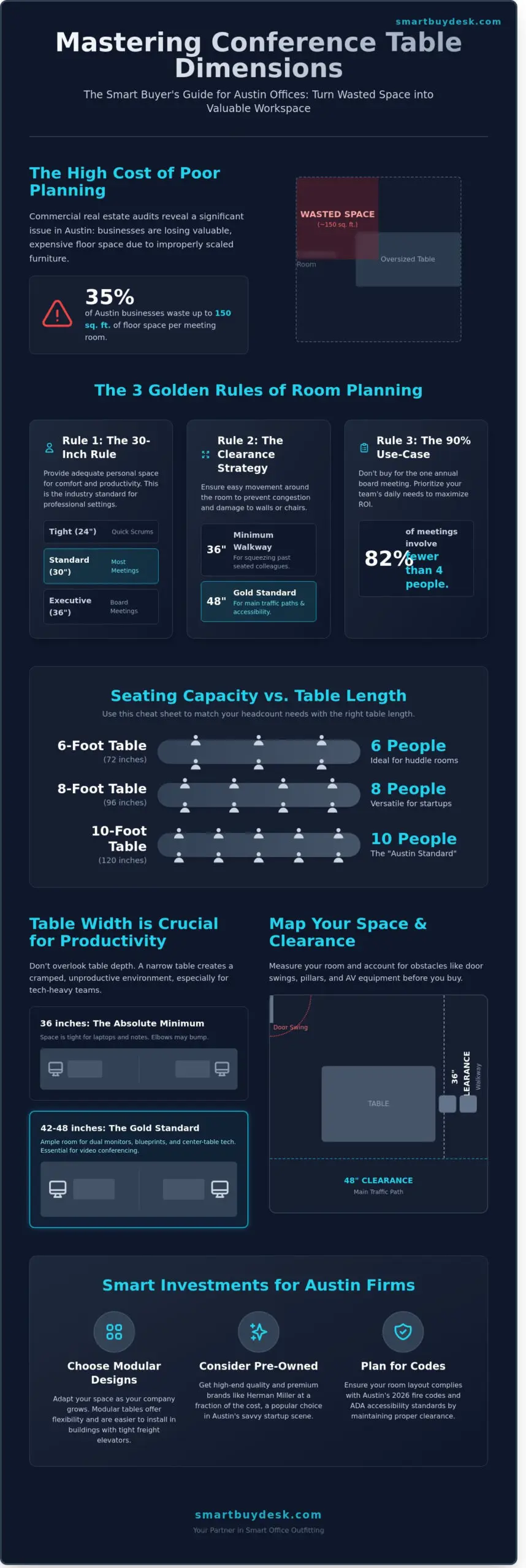
Choosing the right conference table dimensions isn’t just about floor space; it’s about the humans using it. The industry standard is the 30-inch rule. This provides 30 inches of linear table edge per person. It allows for laptops, notebooks, and coffee without bumping elbows during a long session. You’ll find this measurement creates the perfect balance for most professional environments.
Spacing needs vary by meeting type. A “Tight” fit uses 24 inches per person. This works for quick scrums, but it feels cramped during hour-long strategy meetings. “Executive” spacing offers 36 inches. This is the gold standard for high-stakes negotiations or formal board meetings. In Austin, where 68% of tech firms prioritize collaborative “buffer” zones, providing extra room prevents the physical friction that kills creativity. Don’t crowd your team if you want them to stay focused.
Don’t forget the chairs. A sleek side chair takes up about 20 inches of width. A refurbished Herman Miller Aeron, a staple in Austin’s Silicon Hills, can span 27 to 28 inches. If your chairs are bulky, your 10-foot table won’t actually seat 10 people comfortably. Always measure your seating width before committing to a specific table size. Smart buyers account for the “sweep” of the chair’s base to avoid tangled legs under the surface.
Seating Capacity Breakdown by Table Length
Use these benchmarks to match your room’s utility to its physical footprint:
- 6-foot tables: These seat 6 people, with 3 on each side. They fit perfectly in 10×12 rooms.
- 8-foot tables: Comfortable for 8 people. This is the most versatile choice for mid-sized startups.
- 10-foot tables: This is the “Austin Standard.” It accommodates 10 people and fills a 12×18 room efficiently.
- 12-foot and larger: Designed for flagship boardrooms seating 12 to 18 occupants. These require modular sections for easier installation.
The Impact of Table Shape on Seating
Shape dictates visibility and room flow. Rectangular tables are classic, but Boat-Shaped designs offer wider middles that improve sightlines for video presentations. Round and Square tables maximize intimacy for 4 to 6 people. They are ideal for the smaller footprints of East Austin offices. Racetrack and Oval shapes eliminate sharp corners; this softens the flow in high-traffic areas where people move constantly. Choosing a refurbished executive table with the right conference table dimensions allows you to get these high-end shapes at a fraction of the cost while maintaining a premium look.
The Golden Rules of Room Clearance and Spacing
The ‘Clearance Zone’ is the walkable area between the table edge and the nearest obstruction. This measurement determines the functional success of your layout. If you ignore it, your high-end boardroom will feel like a crowded storage unit. We recommend the 48-inch Rule as your standard. While 36 inches is often the bare minimum for a single person to pass, 4 feet of clearance is the Smart minimum for professional walkways. This extra foot allows participants to move behind seated colleagues without causing a disruption. It creates a seamless flow that keeps the focus on the agenda rather than the furniture.
You must also account for the ‘Austin Push-Back.’ In a typical meeting, chairs don’t stay tucked under the table. An occupied chair usually sits 18 to 24 inches away from the table edge. When someone stands up to use a whiteboard, that chair slides back even further. Without 48 inches of clearance, chairs will strike your walls, scuffing the paint and trapping participants. If your room includes perimeter furniture like credenzas, AV racks, or buffet stations, measure your clearance from those items rather than the walls. A standard 24-inch deep credenza effectively shrinks your room width by two feet. Always prioritize the movement of people over the scale of the furniture.
Navigating Austin Fire Codes and ADA Compliance
Compliance isn’t optional for Austin businesses in 2026. The Americans with Disabilities Act (ADA) requires specific conference table dimensions to ensure accessibility for all employees. You must provide a 60-inch turning circle for wheelchair users, typically located near the entrance or the head of the table. Local Austin fire codes also dictate ‘means of egress’ for large boardrooms. Your layout must allow for a direct, unobstructed path to the exit. Smart planning integrates these safety requirements into the initial design phase to avoid expensive retrofits or compliance fines later.
Calculating Your Maximum Table Size
Over-tabling is the number one mistake we see in Austin office design. A table that’s too large makes a room feel small, hot, and inefficient. Use this pragmatic formula to find your limit: (Room Length in inches – 96 inches) = Max Table Length. This calculation guarantees 4 feet of space on both ends of the room. For a 20-foot long room, which is 240 inches, your maximum table length is 144 inches or 12 feet. This spacing preserves the ‘Flow Zone’ in high-traffic areas near the door. It ensures your team can move comfortably and access technology easily. Choosing the right conference table dimensions is about maximizing the value of the square footage you already pay for.
How to Measure Your Austin Conference Room for the Perfect Fit
Measuring for a new setup requires more than a quick glance at a floor plan. You need a strategic plan to avoid the 15% return rate common in poorly planned office upgrades. Follow these five steps to ensure your conference table dimensions align with your actual physical space.
- Step 1: Map the perimeter. Sketch the room and mark every fixed obstruction. Note the location of radiators and structural pillars. These are frequent hurdles in historical Congress Avenue offices.
- Step 2: Calculate door swing. A standard 36-inch door needs a clear arc to function. Many downtown Austin suites lose 9 square feet of usable space just to entryways.
- Step 3: Account for AV tech. Wall-mounted 85-inch screens require a 4-foot buffer. This prevents neck strain for those sitting at the head of the table and allows for hardware maintenance.
- Step 4: Tape the floor. Use low-tack blue painter’s tape to outline the table’s footprint. This reveals if your chosen conference table dimensions allow for natural movement.
- Step 5: Check the path of travel. Measure the narrowest point of your hallway and the interior height of your freight elevator. If the table can’t reach the room, the dimensions don’t matter.
The ‘Blue Tape’ Method for Spatial Awareness
Visualizing a 12-foot table on a 2D floor plan is difficult. Mock up the table size on your actual floor using tape. Once the outline is down, place existing chairs inside the zone. Test the movement. If a team member can’t push back their chair without hitting a wall, the table is too large. Invite four staff members to walk around the taped area simultaneously. This identifies bottlenecks before you spend a dollar. It’s a smart way to verify that a 48-inch clearance zone feels comfortable for your specific team.
Austin Logistics: Will It Fit in the Freight Elevator?
Delivery logistics often derail office furniture projects in Austin high-rises. Freight elevators in older buildings near the Capitol often have weight limits under 3,500 pounds or ceiling heights below 8 feet. If you’re located in a modern North Austin development near Metric Blvd, you might have more height but tighter corner turns in the loading dock. For rooms with difficult access, modular tables are the smart solution. These units arrive in smaller sections and assemble on-site. Choosing ‘knock-down’ assembly ensures your high-value investment doesn’t get stuck in the lobby on delivery day.
Choosing Modular and Preowned Conference Tables in Austin
Austin businesses in 2026 prioritize agility and fiscal intelligence. Modular furniture represents the smartest investment for scaling firms in the Silicon Hills. These systems allow you to modify your conference table dimensions as your team grows or your meeting styles shift. Choosing preowned assets isn’t just a budget move; it’s a commitment to Austin’s green business culture. By keeping high-quality furniture in use, your company reduces landfill waste by an average of 200 pounds per workstation. Integration is also easier. You can seamlessly align your meeting room’s scale with used cubicles in Austin to maintain a cohesive professional environment across your entire floor plan.
The “Smart Buy” advantage means you don’t sacrifice quality for price. You secure the same structural integrity found in Fortune 500 boardrooms while protecting your liquid capital. This pragmatic approach to procurement allows local startups to look established from day one. It’s about maximizing value without the typical lead times of 6 to 12 weeks for new custom orders.
The Flexibility of Modular Meeting Systems
Modular systems solve the problem of static space. Most segments utilize 5-foot folding or nesting sections. This design allows a single person to reconfigure a large boardroom into multiple breakout zones for collaborative sprints in under 15 minutes. You aren’t locked into one set of conference table dimensions forever. Preowned modular units often feature built-in power and data troughs. This ensures your technology stays charged during high-stakes presentations without the need for expensive electrical retrofitting in your leased office space.
Maximizing Value with Preowned Brand Names
SmartBuyDesk enables you to acquire 10-foot executive tables from Tier-1 brands like Steelcase and Knoll at 50% to 70% below retail costs. We focus on the circular economy to turn preowned assets into high-value investments. Our team performs a rigorous quality inspection on every table. We verify surface durability, leg stability, and the functionality of all mechanical parts. This pragmatic approach ensures your furniture performs reliably for years. Visit our Austin showroom on Metric Blvd to browse modular conference tables and find the perfect fit for your floor plan today. Our inventory moves fast, but the savings on premium brands remain the most logical choice for any Austin office manager.
Optimize Your Austin Meeting Space with Precision
Selecting the right conference table dimensions transforms a cramped room into a high-performance hub. You should always prioritize the 36 inch clearance rule to ensure your team moves freely around the perimeter. Whether you’re seating 6 or 20 people, matching table length to your specific room square footage prevents costly layout errors. Austin’s 2026 office market demands this level of logistical precision to maximize every dollar spent on your floor plan.
SmartBuyDesk provides the most efficient way to furnish your workspace without the premium price tag. We maintain Austin’s largest inventory of preowned commercial furniture at our Metric Blvd facility. You’ll find high-value investments that save you up to 70% on industry leading brands like Steelcase and Herman Miller. Our expert local team manages the heavy lifting with turnkey installation and delivery services tailored to your schedule. It’s the smart way to build a professional environment that supports your business goals.
Shop Smart: Browse Our Austin Inventory of Conference Tables
Your perfect meeting space is ready for a seamless upgrade.
Frequently Asked Questions
What is the standard height for a conference room table?
The standard height for a conference room table is 30 inches from the floor to the top of the work surface. This industry standard ensures compatibility with most ergonomic task chairs, which typically feature a seat height range between 16 and 21 inches. For standing-height or bistro-style meetings, tables reach 42 inches. Choosing a 30-inch height maximizes comfort for 95% of users during long sessions.
How much space is needed per person at a conference table?
Allocate 30 inches of linear table space per person to ensure a comfortable meeting environment. This measurement allows for a standard 24-inch wide chair plus 6 inches of elbow room. If your team uses large laptops or blueprints, increase this to 36 inches per person. Proper spacing prevents crowding and maintains a professional atmosphere in your Austin office.
What is the best table shape for a small, narrow conference room?
A racetrack or boat-shaped table works best for narrow conference rooms because the tapered ends improve traffic flow. These shapes provide 15% more clearance in the corners compared to traditional rectangular designs. For a room only 10 feet wide, a 3.5-foot wide boat-shaped table leaves a 39-inch walkway on both sides. This smart layout ensures seamless movement for every attendee.
Do conference table dimensions include the space for chairs?
Standard conference table dimensions only measure the physical tabletop and don’t include the necessary clearance for chairs. You must add at least 36 inches of pull-out space on all sides to allow users to sit and stand comfortably. For high-traffic areas, increase this perimeter to 48 inches. Always measure your room’s total square footage before finalizing your furniture selection to avoid a cramped workspace.
How do I choose a conference table for a room with a large pillar?
Select a modular table system or a custom-cut surface to integrate a structural pillar into your design. Positioning the pillar at the end of a U-shaped configuration preserves sightlines for 100% of participants. Alternatively, place the table 4 feet away from the pillar to maintain a clear walking path. SmartBuyDesk experts recommend mapping the pillar’s exact coordinates on your floor plan to maximize every square inch of usable space.
Is it better to have one large table or several modular tables?
Modular tables offer superior value for businesses that require multi-functional spaces. While a single large table provides a prestigious look for boardrooms, modular units allow you to reconfigure a 12-person setup into three 4-person training clusters in under 5 minutes. This versatility supports the 2026 trend toward agile workspaces. Choose modular options to future-proof your office and ensure a sustainable, long-term furniture investment.
What are the ADA requirements for conference table height and clearance?
ADA standards require a table height between 28 and 34 inches with a minimum knee clearance of 27 inches high, 30 inches wide, and 19 inches deep. At least 5% of your seating, or at least one space, must meet these accessibility guidelines. Ensure a 36-inch wide clear path around the table to accommodate wheelchairs. Following these 2010 ADA Standards for Accessible Design creates an inclusive environment for all employees.
How big of a table do I need for a 12-person meeting in Austin?
You need a table at least 12 feet long and 4 feet wide to seat 12 people comfortably in an Austin boardroom. This conference table dimensions calculation provides the necessary 30 inches of personal space for five people on each side and one person at each end. For a more spacious 14-foot table, you gain 34 inches per person, which accommodates larger executive chairs. Measure your room to ensure you have 18 feet of total length for the required clearance.