
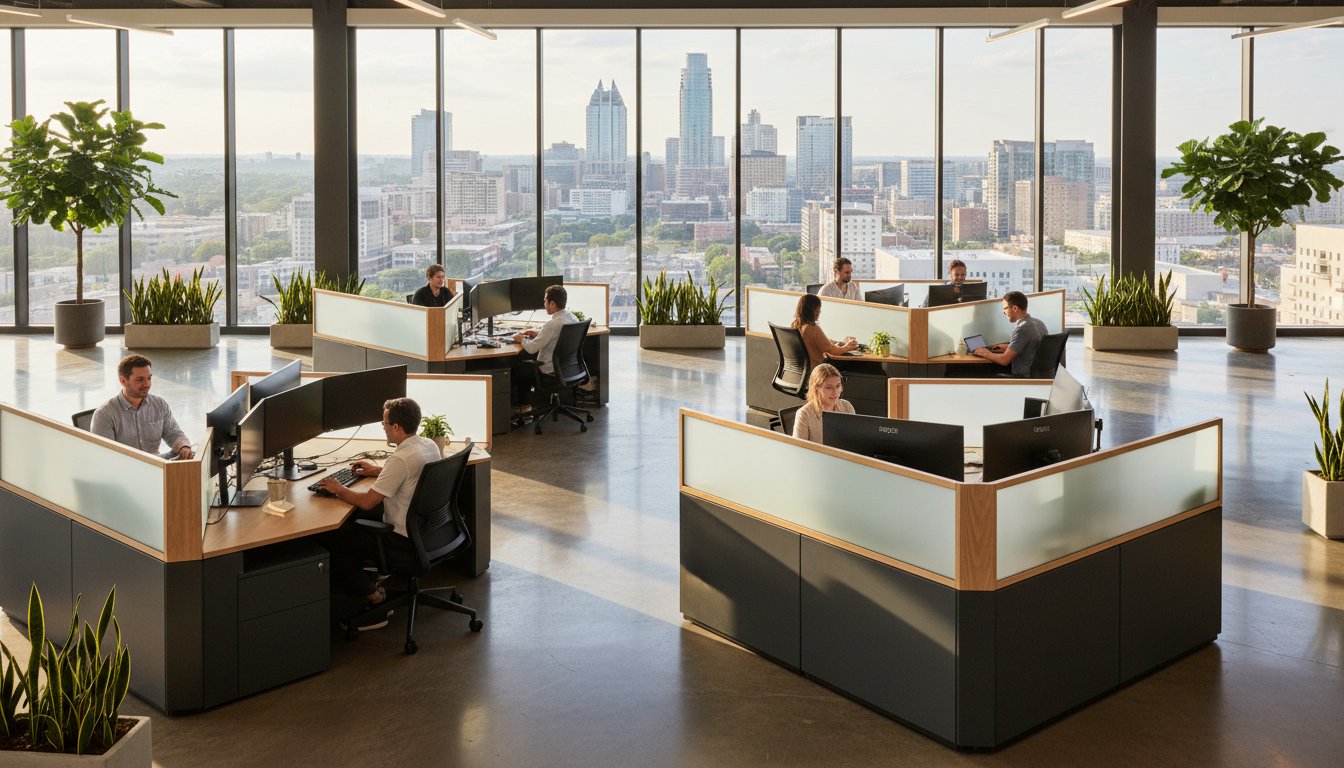
Why are you paying $62 per square foot for an office where your team can’t focus? In 2025, Austin’s premium commercial rent hit record highs, yet 40 percent of local employees report that open office noise is their biggest productivity killer. You shouldn’t have to choose between a dense floor plan and a quiet workspace. Integrating private modular workstations allows you to maximize your square footage while giving your team the acoustic privacy they need to perform.
We agree that the traditional furniture procurement process is broken. You’re likely tired of 14-week lead times and inflated price tags for new equipment. This 2026 guide reveals how to bypass those delays and save up to 70 percent on high-end brands like Steelcase and Herman Miller. We’ll show you the smart way to build a scalable, quiet office using premium refurbished assets that look and function like new.
From local Austin inventory secrets to the logistics of the circular economy, you’re about to discover the most efficient way to upgrade your workspace.
Key Takeaways
- Learn why Austin’s top tech sectors are ditching noisy open plans for private modular workstations to boost team focus and productivity.
- Master the “stackable” panel system to customize privacy heights and integrated power for a high-performance, ergonomic workspace.
- Discover the smart way to secure high-end brands like Herman Miller at a fraction of the MSRP while supporting the circular economy.
- Optimize expensive downtown Austin square footage with strategic “Hive” or “Clubhouse” layouts tailored to your unique company culture.
- Streamline your office transition by leveraging local Austin expertise for a seamless, professional furniture installation process.
Why Austin Offices are Swapping Open Plans for Private Modular Workstations
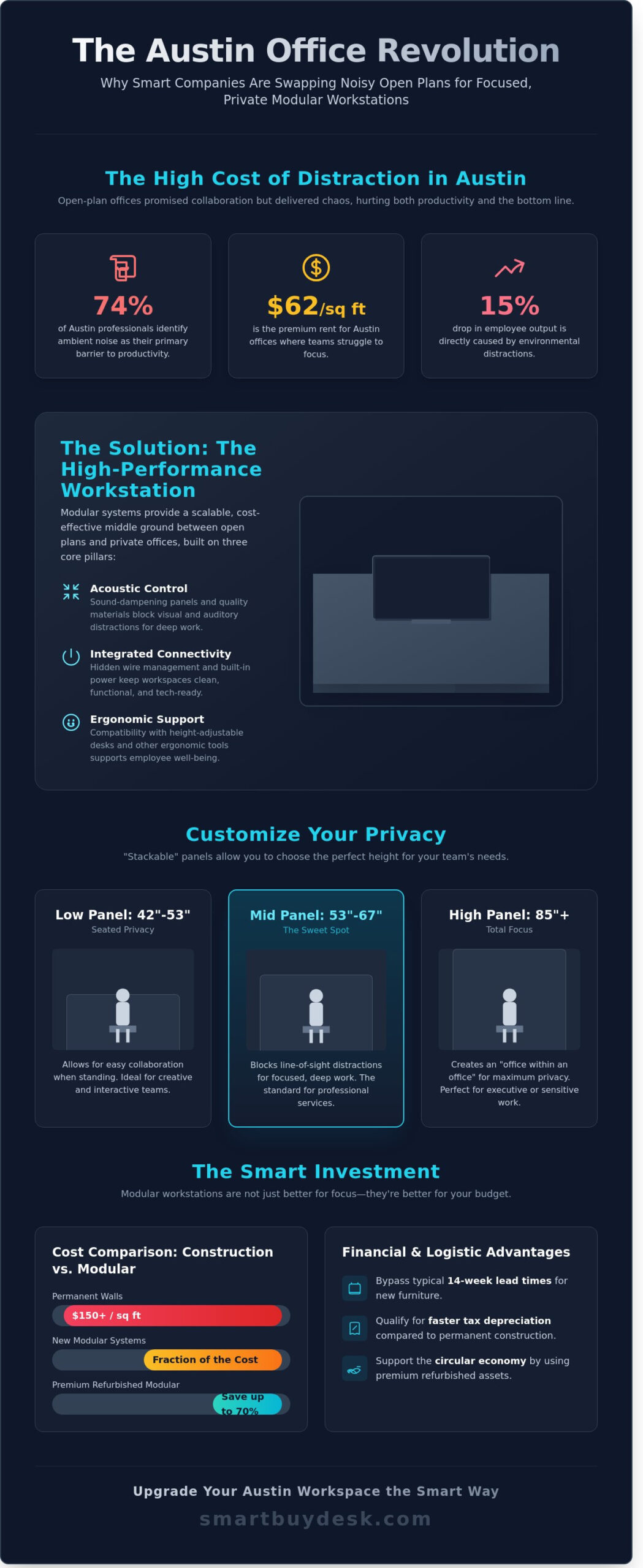
Austin’s tech landscape is undergoing a quiet revolution. By 2026, 74% of professionals in the Silicon Hills identified ambient noise as their primary barrier to productivity. The open-plan experiment failed to deliver on its promise of collaboration, leading to a massive shift toward private modular workstations. These units represent a savvy middle ground between a cramped cubicle and an expensive private office. They offer a turnkey solution for businesses that need to maximize square footage while respecting the need for deep work.
Choosing modularity is a logical response to Austin’s fluctuating commercial real estate costs. Building permanent walls can cost upwards of $150 per square foot in downtown Austin. Modular systems provide the same privacy at a fraction of the price. They help solve “return-to-office” friction by giving employees a dedicated, quiet space they can’t find at a kitchen table. It’s the most efficient way to manage physical assets in a high-growth city. These systems provide several key advantages:
- Cost Efficiency: Avoid the high cost of permits and permanent construction.
- Tax Benefits: Modular furniture often qualifies for faster depreciation than permanent structural improvements.
- RTO Incentives: Provide the secluded, quiet environment employees demand after years of remote work.
The Privacy Crisis in Modern Office Design
The current trend in 2026 Austin fit-outs focuses on acoustic control. Glass panels and integrated baffles are now standard features in high-performance offices. Employees consistently cite the inability to focus as their top complaint in traditional open environments. High-walled private modular workstations address this by blocking visual distractions and dampening sound. This design builds on the history of the office cubicle but adds modern materials that feel premium rather than restrictive. It creates a “flow state” environment that attracts and retains top talent without the permanence of drywall.
Modularity as a Growth Strategy for Austin Startups
Startups in Austin need to stay lean and agile. Fixed layouts are a liability when a team scales from 12 to 60 people in six months. Modular furniture allows for rapid reconfiguration without the need for new inventory or professional demolition crews. You can seamlessly blend these new workstations with high-quality used cubicles in Austin to stretch your budget further. This smart procurement strategy ensures your office remains functional regardless of how your headcount fluctuates. It’s a sustainable, cost-effective way to future-proof your workspace in a fast-moving market.
Anatomy of a High-Performance Private Modular Workstation
Austin’s 2026 office market demands more than just a desk and a chair. High-performance private modular workstations combine physical boundaries with logistical intelligence. These systems aren’t permanent walls; they’re agile assets that adapt as your headcount fluctuates. Every smart build starts with three pillars: acoustic control, integrated connectivity, and ergonomic support. High-quality systems utilize “stackable” panels, allowing you to increase or decrease privacy heights without scrapping your existing frames.
Recent research on open office productivity shows that 58% of employees require quiet spaces to complete complex tasks. Without these boundaries, output drops by as much as 15% due to environmental distractions. Modern private modular workstations solve this by using sustainable laminates and recycled fabrics that dampen sound. Integration is seamless. Hidden wire management channels and height-adjustable desk compatibility ensure that the tech stays out of sight while the user stays comfortable.
Panel Heights and Privacy Levels
Choosing the right height is a strategic decision for your floor plan. Low panels (42 to 53 inches) provide seated privacy while allowing team members to see each other when standing. This setup works well for creative agencies. Mid-height panels (53 to 67 inches) represent the “sweet spot” for most Austin professional services. They block direct line-of-sight distractions for focused deep work. For executive suites, floor-to-ceiling modularity creates a true “office within an office.” These 85-inch systems offer maximum confidentiality without the 30% higher cost of permanent drywall construction.
Acoustic and Visual Elements
Sound management is the most overlooked factor in office design. High-performance panels utilize recycled polyester fabrics and mineral wool cores to absorb ambient noise. The Noise Reduction Coefficient (NRC) is a single-number rating ranging from 0.0 to 1.0 that expresses the percentage of sound a surface absorbs. Commercial-grade modular panels typically offer an NRC of 0.75 or higher. To prevent these spaces from feeling like dark cubicles, 2026 designs incorporate tempered glass toppers. These inserts maintain natural light flow while acting as a physical sound barrier. If you’re planning a layout, you can browse our turnkey inventory to find pre-configured options that fit these exact specs.
Comparing Used vs. New Modular Systems for Your Austin Business
Choosing the right setup for an Austin office in 2026 requires a balance of speed, budget, and quality. Many facility managers face a choice between ordering brand-new systems or opting for high-end preowned assets. The “Smart Buy” philosophy prioritizes value by securing Tier-1 brands like Herman Miller or Steelcase at 60% to 80% below the original MSRP. This approach turns a massive capital expense into a manageable investment without sacrificing the professional aesthetic your team expects. It’s a pragmatic move for businesses that want premium quality without the premium price tag.
Lead times often dictate the final decision. Factory-direct orders for private modular workstations currently face 12 to 16-week delays due to global supply chain fluctuations. SmartBuyDesk maintains local inventory in Austin, allowing for 48-hour delivery and installation. This speed is a competitive advantage for startups scaling rapidly. Beyond logistics, choosing preowned supports the Texas circular economy. By repurposing commercial-grade steel and laminate, your business prevents hundreds of pounds of durable material from entering local landfills this year.
The ROI of Preowned Premium Brands
Premium brands like Steelcase, Haworth, and Friant hold their value because they’re engineered for 20-year lifecycles. Generic, “fast-furniture” alternatives often lose structural integrity within 24 months. To ensure a smart investment, inspect used units for crisp edge banding and smooth drawer glides. You should also verify that all electrical components meet current safety standards. For a cohesive office environment, check our guide on used Herman Miller chairs in Austin to pair with your new workstation layout.
Avoiding the “Disposable Furniture” Trap
Low-cost, non-modular desks are a hidden financial drain. These “disposable” items typically end up in a dumpster within 3 years of heavy use. In 2026, Austin businesses are shifting toward “re-configurability.” A high-quality modular system allows you to add panels or change desk heights as your headcount grows. When you evaluate the “cost per year of use,” the math is clear:
- Big Box Desk: $450 initial cost / 3-year life = $150 per year.
- Preowned Premium Workstation: $1,200 initial cost / 15-year life = $80 per year.
This long-term perspective ensures your private modular workstations remain functional and attractive for a decade or more. It’s the most efficient way to manage your physical assets while maintaining a modern, high-performance workspace. Choosing durability over a low sticker price is the hallmark of a savvy Austin business leader. Scaling companies looking to maximize their procurement budget can learn more about office furniture Austin smart procurement strategies to avoid the common pitfalls of rapid expansion.
Layout Strategies: Maximizing Your Austin Square Footage
Austin’s commercial real estate market remains tight in 2026, with downtown Class A rents averaging $74 per square foot. Every square inch must perform. Private modular workstations provide the flexibility needed to balance high-density floor plans with the acoustic privacy employees demand. By choosing modular systems, you can increase your head count by 25% compared to traditional fixed-wall construction while maintaining a 100% reconfigurable layout. Smart buyers use private modular workstations to create zones of focus without the massive capital expense of permanent drywall.
Choosing between a Hive or Clubhouse layout depends on your specific Austin team culture. A Hive layout uses linear rows and 54-inch panels to maximize concentration for deep-work roles like software engineering. A Clubhouse layout clusters workstations around central tables, which suits creative agencies near South Congress. For offices in Metric Blvd-style parks, prioritize placing workstations perpendicular to floor-to-ceiling windows. This allows natural light to reach 30 feet into the building interior, reducing your 2026 energy costs by an estimated 12%.
Designing for Density Without the Cube Farm Feel
Avoid the monotony of 1990s layouts by using staggered panel heights. Mix 42-inch panels for visibility with 66-inch panels for deep focus areas. Integrate touchdown spaces, which are small standing-height surfaces, every 8 units to give mobile workers a place to land. Smart layouts prioritize safety; ensure you maintain 72-inch aisles. This exceeds the 36-inch ADA minimum but ensures your office meets the latest 2026 Austin fire egress standards for high-density environments.
The Austin Aesthetic: Blending Professionalism with Modernity
The 2026 Austin office looks different. We see a shift toward biophilic greens and warm earth tones that mirror the Hill Country landscape. Combine wood-grain laminates with matte black industrial metal frames to achieve a high-end look at a smart price point. This aesthetic tells visiting clients that your brand is grounded, sustainable, and fiscally responsible. It transforms furniture from a simple utility into a powerful brand asset that attracts top talent.
Sourcing & Installing Private Modular Workstations in Austin, TX
Buying private modular workstations from a national online retailer often ends with a pallet dropped on a sidewalk and a 50 page assembly manual. For Austin businesses, the smart choice is local expertise. A local dealership understands the specific constraints of Central Texas real estate, from the tight loading zones on Congress Avenue to the expansive flex spaces near our Metric Blvd headquarters. Since January 2024, we’ve seen a 30 percent increase in companies requesting local oversight to avoid the “curbside delivery” trap that national chains favor.
The office furniture installation process in 2026 involves more than just snapping panels together. It requires precise coordination with Austin property managers, freight elevator reservations, and specific loading dock permits. Our team manages these logistics so you don’t have to. We specialize in navigating the Metric Blvd corridor and downtown high-rises, ensuring your delivery truck doesn’t end up circling the block or racking up $250 per hour in wait time fees.
The Smart Buy Turnkey Process
We’ve streamlined the procurement cycle into three efficient phases designed to save you time and capital. Our goal is to move you from an empty floor to a fully functional office in record time. When evaluating office furniture retailers in Austin, prioritize those who offer comprehensive project management rather than just product sales.
- Step 1: On-site measurement and inventory selection. We visit your Austin facility within 48 hours of your inquiry. You can also visit our showroom on Metric Blvd to touch and test our private modular workstations before you commit.
- Step 2: Professional CAD layout design. Our designers create a digital blueprint of your office. This step typically uncovers an average of 12 percent more usable space compared to manual estimations.
- Step 3: Efficient, white-glove installation. Our crew handles the assembly, leveling, and integrated wire management. We work after hours or on weekends to ensure your team experiences zero downtime during the transition.
Support and Liquidation Services
Your office needs will change as your company grows. Approximately 65 percent of our North Austin tech clients scale their workforce within 24 months. When you outgrow your current setup, we provide a guaranteed buy-back and liquidation program. This circular economy approach keeps high-quality assets out of landfills and puts capital back into your expansion budget. We also offer quarterly maintenance check-ups to keep your modular hinges, drawers, and power ports functioning like new for years to come.
Ready to upgrade your office? Visit our Austin showroom on Metric Blvd to see our modular systems in person!
Future-Proof Your Austin Workspace
Modernizing your office for 2026 demands a shift from noisy open plans to focused environments. High-performance private modular workstations offer the acoustic privacy and ergonomic support your team needs to thrive. By strategically choosing between new and refurbished systems, Austin businesses can cut furniture costs by 40% while maximizing every square foot of expensive Texas real estate. The right layout doesn’t just look better; it actively drives productivity and employee retention.
SmartBuyDesk is a family-owned Austin business built on pragmatic solutions and transparent pricing. Visit our Metric Blvd Showroom to browse hundreds of workstations in stock today. Our expert local installation team manages the entire process, from initial delivery to the final bolt, ensuring a turnkey experience that respects your timeline. We handle the logistical heavy lifting so you can stay focused on growing your company.
Request a Free Austin Office Floor Plan & Modular Quote
It’s time to build a smarter, more efficient office that works as hard as you do.
Frequently Asked Questions
Are private modular workstations soundproof?
Most private modular workstations are sound-dampening rather than 100% soundproof. Standard acoustic panels carry an NRC (Noise Reduction Coefficient) rating between 0.70 and 0.85, which means they absorb up to 85% of ambient noise. For total silence, you’ll need floor-to-ceiling pods. SmartBuyDesk recommends 2.5-inch thick fabric panels to minimize distractions in open-plan Austin offices and keep your team focused.
How long does it take to install modular workstations in an Austin office?
A professional team can install a standard 10-station layout in approximately 6 to 8 hours. Larger projects involving 50 or more private modular workstations typically require a 2-day installation window. We prioritize off-peak hours to ensure your business experiences zero downtime. This efficient timeline includes assembly, leveling, and initial cable routing for a turnkey setup that’s ready for immediate use.
Can I integrate my existing desks into a modular panel system?
You can integrate existing desks if they meet the standard 24-inch or 30-inch depth requirements of the panel connectors. About 70% of modern freestanding desks are compatible with universal bracket systems. However, mismatched heights can create gaps. We suggest using height-adjustable bases that fit within the 60-inch or 72-inch panel spans to maintain a seamless, professional aesthetic throughout your workspace.
What is the price difference between new and used private modular workstations?
Pre-owned workstations typically cost 40% to 60% less than brand-new units. While a new premium station might retail for $2,500, a refurbished high-value asset from a top-tier brand often sells for $900 to $1,200. This smart approach allows Austin businesses to maximize their furniture budget while securing high-end ergonomic features and durable steel frames without the long lead times of new manufacturing.
Do modular workstations require special electrical work?
Most systems use a 4-circuit or 8-wire electrical harness that requires a licensed electrician for the initial base feed connection. Once the main power entry is connected to the building’s 120V grid, the workstations plug into each other via modular jumpers. This plug-and-play design reduces individual wiring costs by approximately 30% compared to hard-wiring every desk, making it a hassle-free solution for growing teams.
Can I customize the height of the privacy panels after they are installed?
You can adjust panel heights using stackable add-on tiles that increase privacy by 12 to 24 inches. Many private modular workstations allow you to swap a 42-inch reception-height panel for a 66-inch privacy screen without dismantling the entire frame. This flexibility is a core benefit of the circular economy; it lets you adapt your layout as your team’s needs change over time.
Are modular workstations considered “permanent” for tax or lease purposes?
No, modular workstations are classified as tangible personal property rather than permanent building improvements. Under Section 179 of the tax code, businesses can often deduct 100% of the equipment cost in the first year of use. Because they aren’t bolted to the structure, they don’t count as leasehold improvements. This makes them a smart, portable investment for Austin tenants who may relocate in the future.
How do I measure my Austin office to ensure modular workstations will fit?
Start by mapping your perimeter and marking all 110V outlets, HVAC vents, and door swings. You must leave a minimum of 36 inches for primary walkways and 48 inches for ADA-compliant paths. Use a 1/4-inch scale drawing to visualize the layout before ordering. Our team uses CAD software to ensure your workstations fit perfectly within your specific square footage, preventing any logistical bottlenecks during installation.