

Wasted square footage in a high-growth Austin tech corridor isn’t just an eyesore. It’s a direct leak in your annual capital expenditure budget. You know that a professional storage cabinet should do more than hold files. It must actively optimize your floor plan while mitigating the $50,000 risks associated with regulatory data breaches. Managing these physical assets requires a strategic approach to keep your facility compliant and efficient.
The logistical friction of large-scale furniture delivery often disrupts operational momentum. This guide provides the technical roadmap to master commercial procurement in Central Texas. You’ll learn how to maximize spatial efficiency using modular configurations and ensure your layout adheres to the latest Texas Accessibility Standards.
We’ll analyze the ROI of premium pre-owned assets from manufacturers like Steelcase and Herman Miller. We also examine how to integrate high-density storage into your architectural blueprints for a seamless installation. From the corporate sectors of Round Rock to the technology hubs in Austin, this is your blueprint for a streamlined, high-performance workspace.
Key Takeaways
- Master the space utilization matrix by integrating modular storage systems with existing panel heights to reclaim wasted square footage in open-plan layouts.
- Mitigate liability by selecting a commercial-grade storage cabinet that meets stringent HIPAA standards and offers fireproof protection for sensitive corporate data.
- Optimize capital expenditure by differentiating between performance laminate and heavy-gauge steel to ensure maximum resource longevity and ROI.
- Simplify complex logistics through professional architectural blueprint reviews and strategic furniture evaluations at the Round Rock regional hub.
Optimizing Square Footage with Modular Storage Systems
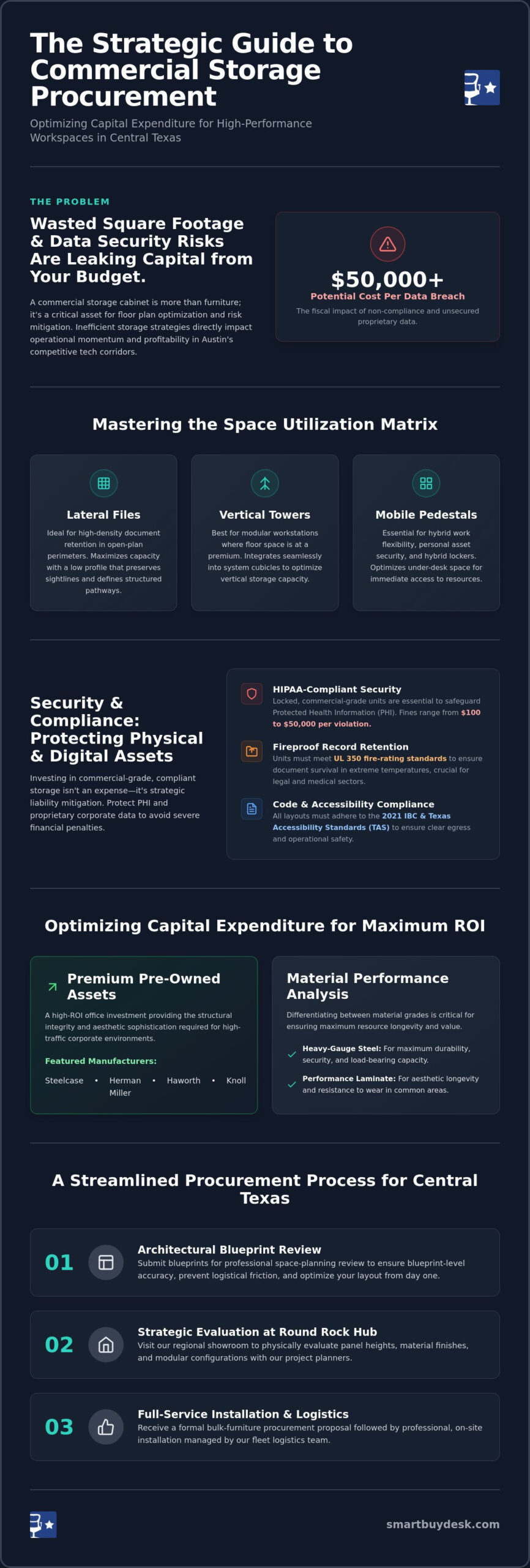
Modern facility management treats the storage cabinet as a critical modular component within a broader space utilization matrix. Rather than viewing filing units as static furniture, we position them as functional partitions that define workspace boundaries. Integrating lateral files with system cubicles allows facilities directors to create structured pathways without the permanence of drywall. This smart procurement strategy ensures that every square foot of your Austin technology corridor office remains productive and organized.
To better understand the functional organization of these high-density units, watch this helpful video:
Leveraging premium pre-owned assets from manufacturers like Steelcase or Herman Miller provides a high-ROI office investment. These units offer the structural integrity needed for high-traffic environments while allowing procurement managers to maximize their capital expenditure. By opting for liquidated commercial value over lower-grade retail alternatives, organizations in Williamson County can maintain a sophisticated aesthetic without compromising on long-term durability.
Lateral vs. Vertical Configurations for High-Density Layouts
Footprint efficiency is the primary metric when evaluating lateral files for high-traffic corridors. These units provide high-capacity storage while maintaining a low profile that preserves sightlines. Facilities directors often reference a Filing cabinet overview when establishing baseline requirements for diverse document formats.
- Lateral Files: Ideal for high-density document retention in open-plan perimeters.
- Vertical Towers: Best for modular workstations where floor space is at a premium.
- Mobile Pedestals: Essential for hybrid lockers and personal asset security.
Professional office space planning ensures these units are placed with blueprint-level accuracy to prevent logistical friction. This precision is essential for maintaining clear egress paths in accordance with Austin building codes.
Integrating Storage with Existing Cubicle Systems
Structural compatibility is vital when adding storage to active layouts. We ensure seamless integration with established brands like Friant and Steelcase. To support hybrid work flexibility, optimize under-desk space with mobile pedestals. These units allow for panel-height optimization, balancing acoustic privacy with immediate access to physical resources.
Ready to optimize your Austin facility? Our Round Rock showroom serves as a regional hub where executives can evaluate panel heights and consult with project planners. To begin your high-ROI office investment, you can submit architectural blueprints for a professional space-planning review, schedule an on-site consultation for custom layouts, or request a formal bulk-furniture procurement proposal today.
Security and Compliance: Protecting Physical Assets and Sensitive Data
Facility directors often hesitate at the higher capital expenditure required for high-security units. However, a standard storage cabinet provides little defense against the fiscal impact of a data breach. With over 156,874 HIPAA violation complaints logged since 2003, the cost of non-compliance is steep. Fines range from $100 to $50,000 per violation. Investing in locked, commercial-grade units is a strategic move to safeguard Protected Health Information (PHI) and proprietary corporate data.
Procuring Fireproof File Cabinets for Legal and Medical Sectors
Austin law firms and medical facilities in the technology corridor face unique risks regarding record retention. All commercial remodeling projects in Austin must comply with the 2021 International Building Code (IBC) and Texas Accessibility Standards (TAS). Fireproof units must meet the UL 350 fire-rating standard to ensure documents survive extreme temperatures. These cabinets also provide impact resistance; this is critical if a floor collapses during a structural fire. You can evaluate these high-security options at our office furniture shop to see how they integrate into your current layout.
Centralized Locker Systems for Hybrid Workforce Management
The rise of “hot-desking” in Austin tech hubs has shifted the focus from individual desks to centralized storage. Implementing an office locker or high-density storage cabinet system allows facilities managers to reclaim square footage while providing employees with secure personal space. Modern configurations now utilize RFID and digital locking systems. This technology streamlines access management and eliminates the logistical friction of physical keys. Choosing durable steel construction ensures these assets withstand high-turnover environments in Williamson County corporate sectors.
Effective document management requires a balance between centralized and decentralized storage. Centralized banks of lateral files maximize spatial efficiency in open-plan layouts. Conversely, decentralized mobile pedestals support individual modular workstations for immediate access. If you are planning a new facility in Westlake or Georgetown, consider a professional on-site consultation to determine the ideal security configuration for your footprint.
Evaluating Material Durability and Aesthetic Longevity
Commercial environments demand a higher tier of material resilience than residential settings. While retail-grade particle board often suffers from delamination and structural failure, a professional storage cabinet utilizes high-pressure laminate (HPL) or heavy-gauge steel. These materials ensure that your investment maintains its structural integrity through years of heavy use in high-traffic Austin technology corridors. Choosing the right substrate is a critical step in managing your cost-effective capital expenditure.
For facilities managers outfitting office kitchenettes or breakrooms that require a more residential feel, DIY Depot USA offers high-quality shaker cabinets and renovation products that combine durability with cost-efficiency.
Performance Laminate: Balancing Aesthetics and Scratch Resistance
High-pressure laminate is the industry standard for commercial durability. It offers superior scratch resistance and impact protection compared to low-cost alternatives that warp under the weight of bulk document storage. To extend the service life of your assets, implement regular maintenance protocols. If minor wear occurs, facilities managers can refer to this professional guide on laminate repair techniques to restore the finish and protect your long-term ROI.
Steelcase and Herman Miller: The Gold Standard of Resale Value
Premium manufacturers like Steelcase, Herman Miller, and Knoll are engineered for multiple lifecycles. These brands hold significant liquidated commercial value because their internal mechanisms and steel chassis don’t degrade like consumer products. When procuring premium pre-owned assets, you must evaluate the structural integrity of refurbished versus “as-is” units. Refurbished cabinets often feature fresh powder coating and serviced locking bars, ensuring they perform like new in your Williamson County corporate sector facility. Facilities directors who also invest in Steelcase seating should review the technical process of how to adjust Steelcase Leap V2 chairs to maximize the ergonomic ROI of their premium pre-owned assets.
Maintaining corporate brand consistency across departments requires strategic color-matching. Whether you are outfitting a new floor in Westlake or expanding in Georgetown, selecting neutral commercial finishes allows for future scalability. Standardizing your storage cabinet fleet simplifies long-term asset management and ensures a cohesive aesthetic throughout the workspace. You can contact our project planners today to discuss color-matching and technical specifications for your next bulk-furniture procurement proposal.
Procurement Logistics: From Blueprint Review to Installation
Successful procurement moves beyond product selection into a professional logistics framework. Your facility’s transition from architectural blueprints to a fully functional workspace requires a partner who manages the complexities of fleet logistics. Our Round Rock showroom serves as the regional hub for this process. Here, executives can evaluate panel heights and consult with project planners to ensure every storage cabinet integrates perfectly with their existing footprint.
The ROI of Liquidated Commercial Value and Pre-owned Assets
Choosing premium pre-owned storage is a strategic way to calculate cost-effective capital expenditure. High-ROI office investments in brands like Steelcase or Herman Miller reduce long-term depreciation. These assets retain their liquidated commercial value far longer than consumer-grade alternatives. This approach allows facilities directors to allocate more budget toward ergonomic compliance and high-density modular workstations without sacrificing structural quality.
Full-Service Installation in Central Texas Tech Corridors
Managing large footprints in the Austin technology corridors requires professional delivery and installation services that minimize operational downtime. We coordinate with facilities directors to implement after-hours or phased installation schedules. For complex modular layouts in Williamson County and Westlake, an on-site consultation ensures structural compatibility. This level of coordination prevents the logistical friction common in large-scale furniture deployments.
Sustainable asset management also relies on a structured approach to decommissioned inventory. Integrating furniture liquidation into your procurement cycle allows for a smooth transition between old and new configurations. If your organization is preparing for a workspace decommission, our Austin office furniture liquidation and strategic asset recovery checklist provides a professional roadmap to help you sell used office furniture in Austin’s technology corridors while recouping maximum capital. This process ensures that your physical resources are managed with the same savvy intelligence as your financial capital.
Optimize your facility procurement today. We provide three specific options to move your project forward:
- Submit architectural blueprints for a professional space-planning review.
- Schedule an on-site consultation for custom modular layouts in your facility.
- Request a formal bulk-furniture procurement proposal tailored to your budget requirements.
Visit our Round Rock showroom to test modular configurations and consult with our experts on your next high-ROI office investment.
Secure Your High-ROI Workspace Strategy
Strategic facility management requires a shift from viewing furniture as a utility to treating it as a high-ROI capital expenditure. By integrating modular storage cabinet systems into your space utilization matrix, you reclaim valuable square footage while meeting stringent security standards. Leveraging premium pre-owned assets from manufacturers like Steelcase and Herman Miller ensures your procurement budget goes further without sacrificing structural integrity. These assets provide the durability required for the high-traffic environments found in the Austin technology corridors.
Our Round Rock showroom serves as a regional hub where executives can evaluate these modular configurations firsthand before commitment. We specialize in fleet logistics and full-service installation across Central Texas, including Williamson County and Westlake. We manage the complexities of logistical coordination so you can focus on your primary operational objectives. Every procurement decision you make today should support the long-term scalability of your facility.
Take the next step in optimizing your corporate footprint with these three options:
1. Submit architectural blueprints for a professional space-planning review.
2. Schedule an on-site consultation for custom modular layouts.
3. Request a formal bulk-furniture procurement proposal from our Round Rock experts.
We look forward to facilitating your next seamless workspace transition and helping you build a more efficient, compliant office environment.
Frequently Asked Questions
What is the difference between lateral and vertical storage cabinets for office use?
Lateral units provide high-capacity storage and often serve as functional partitions to define boundaries within an open-plan layout. Vertical units occupy a significantly smaller footprint and are better suited for individual modular workstations where aisle space is restricted. Selecting the right configuration depends on your space utilization matrix and the specific document volume your Austin facility requires.
How do I ensure my office storage meets fire safety compliance for legal records?
To protect critical legal records, you must procure a storage cabinet with a UL 350 fire-rating. This certification ensures the unit protects paper documents from extreme heat and structural impacts during a building fire. Austin facilities directors should also verify that placement complies with the 2021 International Building Code (IBC) to ensure clear egress paths in high-occupancy corridors.
Can pre-owned storage cabinets be integrated with new modular workstations?
Premium pre-owned assets from manufacturers like Steelcase and Herman Miller are designed for modular compatibility with new system cubicles. These high-ROI office investments maintain their structural integrity across multiple lifecycles, allowing for seamless aesthetic integration. You can evaluate these configurations at our Round Rock regional hub to ensure structural and color-matching consistency across your entire footprint.
What are the benefits of performance laminate over traditional wood for office storage?
Performance laminate provides superior scratch resistance and impact protection compared to traditional wood veneers that warp under heavy document loads. It’s an intelligent cost-effective capital expenditure because it withstands the rigors of high-traffic technology corridors in Austin and Westlake. This material ensures long-term aesthetic longevity while requiring minimal maintenance compared to organic wood surfaces.
How does professional office furniture installation differ from residential assembly?
Professional office furniture installation involves complex fleet logistics and precise alignment with architectural blueprints to ensure structural safety. Unlike basic residential assembly, this process includes the strategic deployment of a storage cabinet fleet across a whole-office footprint. Our team manages these transitions throughout Williamson County and Georgetown to prevent operational friction and ensure compliance with Texas Accessibility Standards (TAS).