

Most Austin facilities managers view office decommissioning as a simple logistical chore. In reality, it’s one of the most critical financial recovery phases in a corporate lease lifecycle. Learning how to decommission an office in Austin correctly prevents the common fear of losing high security deposits due to minor lease non-compliance. It also ensures you don’t leave money on the table when clearing out high-value modular workstations and system cubicles.
We understand that coordinating multiple vendors across the Austin technology corridors or Round Rock corporate sectors is inherently stressful. You’ve likely invested heavily in premium assets from manufacturers like Steelcase or Herman Miller; watching those become a disposal expense is a significant waste of capital. This guide provides a strategic roadmap to master these complexities, protecting your lease deposit while maximizing the liquidated commercial value of your inventory.
You’ll learn how to navigate local regulations like the Universal Recycling Ordinance to avoid potential fines of $2,000 per day. We also preview the best methods for achieving a seamless transition to a new footprint using high-ROI office investments. By following this structured approach, you’ll transform a logistical burden into a streamlined asset recovery project.
Key Takeaways
- Conduct a thorough lease audit to define “broom-clean” standards and mitigate financial liabilities before starting the restoration process.
- Master the technical steps of how to decommission an office in Austin to protect your security deposit and ensure full compliance with landlord requirements.
- Maximize the liquidated commercial value of your modular workstations and system cubicles by integrating professional asset recovery into your decommissioning timeline.
- Deploy specialized teams for the disassembly of premium assets from manufacturers like Steelcase and Herman Miller to prevent property damage during extraction.
- Execute a fail-safe facility handover protocol in Central Texas corporate sectors by securing a final sign-off from building management.
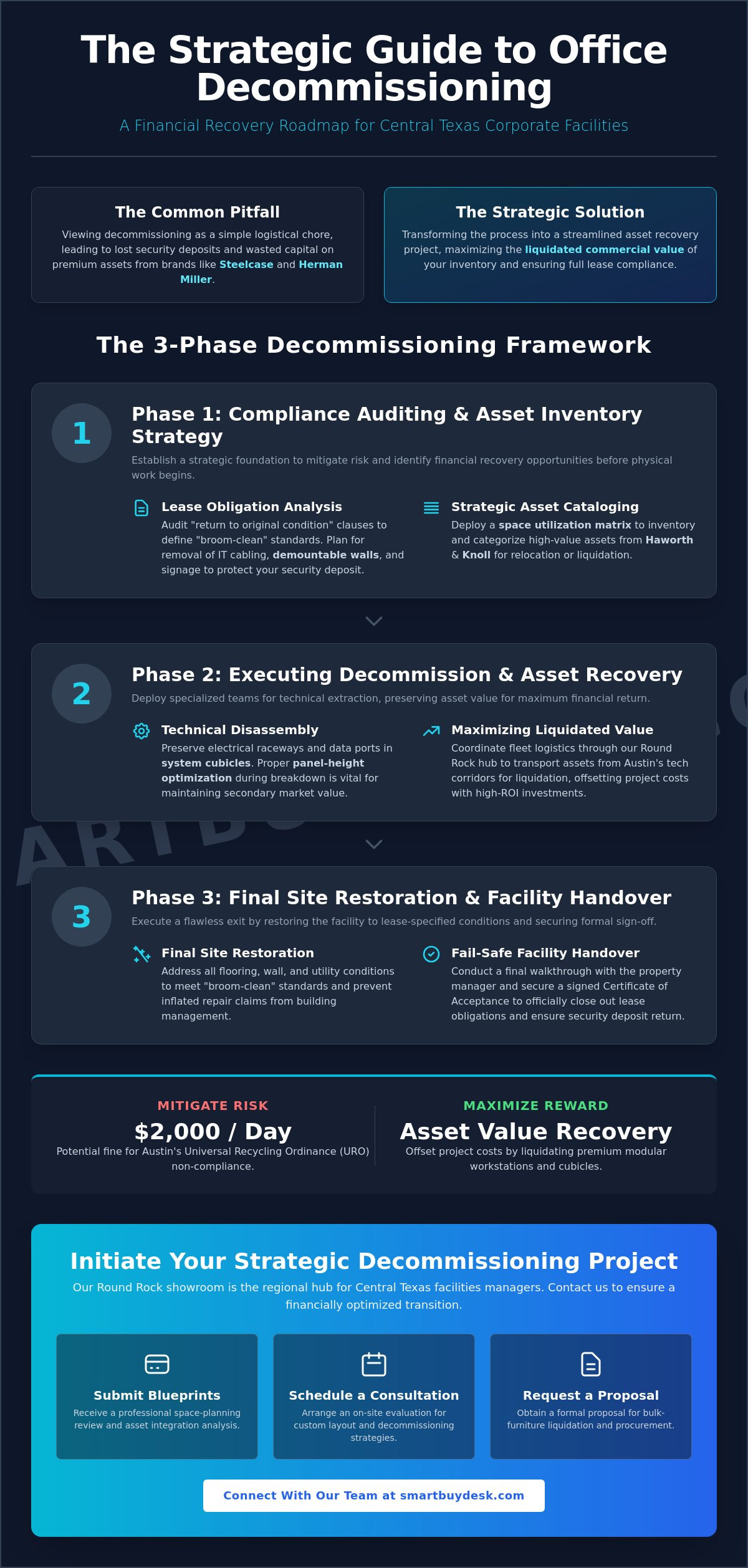
Phase 1: Compliance Auditing and Asset Inventory Strategy
Successful workspace transitions begin with a clear understanding of the decommissioning process. For facilities directors in the Austin technology corridors, this isn’t a simple move; it is the systematic restoration of a commercial footprint to the “broom-clean” standards mandated by your lease. Mastering how to decommission an office in Austin requires a dual focus on logistical precision and financial recovery.
Early coordination with property management is vital for maintaining your project timeline. You must secure freight elevator access and loading dock schedules well in advance, particularly in high-traffic areas like Westlake or the Round Rock corporate sectors. Managing these local logistics ensures your team avoids the common bottleneck of restricted site access during the final days of occupancy.
To better understand the scope of these requirements, watch this helpful video on preparation strategies:
Lease Obligation and Restoration Analysis
Analyze your “return to original condition” clauses to prevent unexpected restoration bills from landlords. In Williamson County and downtown Austin, these clauses often require the complete removal of IT cabling, demountable walls, and custom signage. Documenting the current condition of your flooring and partitions is essential to protect your security deposit from inflated repair claims. Ensure your plan accounts for Austin-specific codes to avoid the $2,000 per day penalty associated with Universal Recycling Ordinance (URO) non-compliance.
Strategic Asset Cataloging
Establish a space utilization matrix to categorize every piece of furniture for relocation, liquidation, or certified disposal. This is the time to inventory premium pre-owned assets from manufacturers like Herman Miller, Steelcase, and Haworth. Identifying which modular workstations and system cubicles hold the highest liquidated commercial value allows you to offset decommissioning costs. If you’re transitioning to a new footprint, leverage office-space-planning-design to see how your existing modular conference tables can be integrated into your next high-ROI workspace.
Phase 2: Executing the Decommission and Asset Recovery
Understanding how to decommission an office in Austin involves more than just clearing space. It requires a specialized approach to office-furniture-liquidation to offset the overall project costs. By treating your furniture as a recoverable investment rather than a disposal burden, you protect your bottom line. If you are managing a high-ticket workspace transition, a professional liquidation assessment provides the financial clarity needed for executive sign-off.
Technical Disassembly of System Cubicles
Generic movers often damage critical components during the breakdown of complex layouts. Our teams focus on panel-height optimization and the careful preservation of electrical raceways and data ports. This technical care is vital for maintaining the secondary market value of system cubicles from manufacturers like Knoll or Haworth. For a step-by-step breakdown of these protocols, refer to our office-furniture-liquidation-checklist to ensure your team follows industry best practices.
Maximizing Liquidated Commercial Value
Not all assets are equal in the recovery market. High-ROI office investments like Steelcase Leap V2 chairs or height-adjustable desks command premium pricing compared to standard laminate surfaces. Facilities managers should consult our used-cubicles-austin-guide to align their inventory with current demand from local developers. This strategic alignment ensures you receive the highest liquidated commercial value for your modular workstations. Executing a commercial furniture disposal Austin strategy for non-liquidatable items is the final step to meet corporate sustainability mandates while clearing the floor for the next phase.
Phase 3: Final Site Restoration and Facility Handover
The final stage of the process involves restoring the physical environment to the specific “broom-clean” condition required by Central Texas commercial leases. This is a critical step in mastering how to decommission an office in Austin because failure to meet these standards often results in heavy deductions from your security deposit. Execute a deep-clean protocol that addresses every square foot, ensuring the space is ready for immediate re-leasing by the landlord.
Security is paramount during this final phase. Ensure all proprietary data is destroyed through certified IT asset disposition (ITAD) protocols before the final walkthrough occurs. For any premium pre-owned assets not included in the liquidation phase, transition them into commercial-moving-storage. This allows for future fleet deployment across your other regional locations while keeping your current site clear for handover.
To manage asset overflow or secure equipment during the final site restoration, many project leads visit Container City for durable shipping containers that provide flexible storage solutions throughout Central Texas.
Infrastructure and Code Compliance
Landlords in the Austin technology corridors expect the removal of all non-standard IT cabling and the restoration of electrical systems to their original configuration. Dismantle both interior and exterior signage, taking care to patch wall surfaces and match paint where necessary. If you are reversing complex modular layouts, consult our office-furniture-installation-guide for insights on how to handle the mechanical breakdown of integrated power systems without damaging the building’s core infrastructure.
Final Handover Documentation
Protect your organization from post-move-out damage claims by creating a comprehensive photographic record of the restored space. This documentation serves as undeniable proof of compliance with your lease obligations. Perform a final walkthrough with building management to sign off on property protection and restoration. Once you verify that all access cards, keys, and facility manuals are returned, you can trigger the release of your high-value security deposit. Finalizing the project with a detailed asset recovery report ensures your capital expenditure budget reflects the liquidated commercial value returned from your system cubicles and modular workstations. Following these steps is the most efficient way to understand how to decommission an office in Austin while protecting your corporate interests.
Secure Your Lease Deposit and Maximize Asset Value
Executing a successful workspace transition requires more than just clearing the floor. It demands a precise adherence to “broom-clean” lease standards and a technical approach to recovering liquidated commercial value. Mastering how to decommission an office in Austin ensures your organization avoids regulatory penalties while protecting its high-value security deposits.
As an authorized liquidator for Herman Miller and Steelcase assets, we specialize in high-ticket commercial projects that require technical disassembly and strategic recovery. Our regional fleet logistics hub in Round Rock serves the entire Central Texas corridor, providing the infrastructure needed for seamless transitions. We handle the complexities of system cubicles and modular workstations so your team can focus on its primary operational goals.
Take the next strategic step in your decommissioning project:
- Submit architectural blueprints for a professional space-planning and asset recovery review.
- Schedule an on-site consultation for a custom liquidation and decommissioning layout today.
- Request a formal bulk-furniture procurement proposal to optimize your next workspace footprint.
Visit our Round Rock showroom to evaluate panel-height optimization and consult with our project planners on your upcoming transition. We look forward to facilitating your most efficient move yet.
Frequently Asked Questions
What is the difference between office moving and office decommissioning in Austin?
Office moving focuses on the logistics of transporting assets to a new site, while decommissioning is the technical restoration of your current workspace to meet “broom-clean” lease obligations. Understanding how to decommission an office in Austin involves the complete removal of all modular workstations, IT cabling, and demountable walls. This process ensures the facility is returned to its original condition, protecting you from landlord restoration penalties.
How long does the decommissioning process typically take for a 20,000 sq. ft. Austin office?
A 20,000 sq. ft. project generally requires a timeline of two to four weeks for full execution. This window accounts for the technical disassembly of system cubicles and the coordination of fleet logistics through regional hubs like Round Rock. Factors such as freight elevator access in the Austin technology corridors and the complexity of your space utilization matrix will influence the final schedule.
Will I get my full security deposit back if I leave my used cubicles behind?
Leaving furniture behind is almost always a breach of contract that results in significant security deposit deductions. Landlords typically charge for the removal and disposal of abandoned assets, with restoration charges often ranging from $50 to $500 per office depending on the scope. To avoid these costs, you must master how to decommission an office in Austin by clearing the entire floorplate and restoring all surfaces to the standards specified in your commercial lease.
How do I calculate the liquidated commercial value of my existing office furniture?
You calculate liquidated commercial value by auditing your inventory for premium pre-owned assets from manufacturers like Herman Miller, Steelcase, and Knoll. Factors such as the age of the modular workstations, the condition of the finishes, and the presence of integrated power systems determine the return. High-ROI office investments like ergonomic seating and height-adjustable desks often retain a higher percentage of their original cost than standard laminate surfaces.